Mashrabiya, the wooden screen that shades a room
How Cairo's turned wooden lattice screens filtered sun, let air through and kept a home private, and what the idea can do for a fitted room today.
By the Ajusteur team5 minute read
In this essay
A window made of small pieces of wood
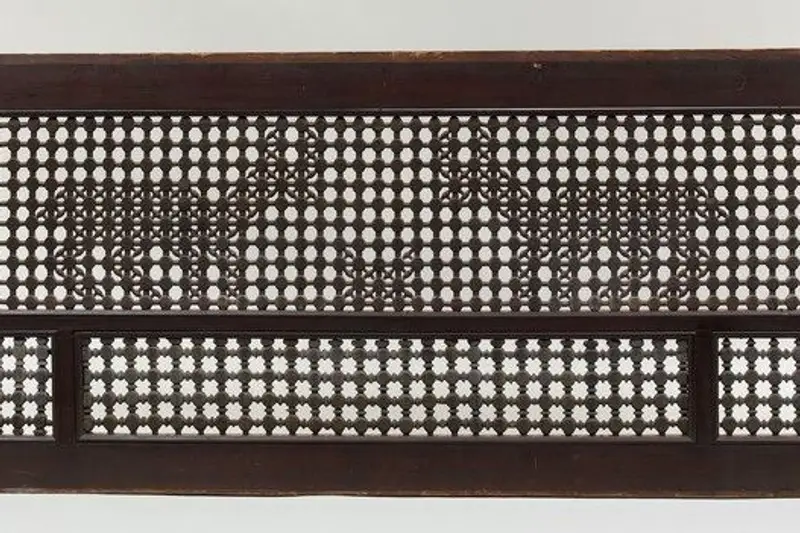
Picture a street in old Cairo. Above the shops, the upper floors are wrapped in dark wooden lattice, thousands of little turned pieces catching the light. The Met calls these turned wood screens, mashrabiyyas, a characteristic feature of Cairo's cityscape.
They were used inside buildings and out: on balconies, in windows, and as partition screens between rooms. So it was never only a window. It was a way of building a wall that breathes.
Source: The Met: Mashrabiyya Screen with Two Gazelles, Egypt, 18th or 19th century
Shade, air and privacy in one screen
The Met puts the job description in one sentence: mashrabiyyas filtered the bright sunlight and let air through while keeping a home private. Three problems, one screen, no electricity.
Some projected out from the wall as a small bay. The encyclopaedia entry describes them catching the wind for passive cooling, and jars or basins of water placed inside to cool by evaporation. Privacy, it adds, was one of the main purposes: you could see the street, and the street could not see you.
Sources: The Met: Mashrabiyya Screen with Two Gazelles, Egypt, 18th or 19th century, Wikipedia: Mashrabiya
How do the pieces hold together?
This is the part a joiner loves. The Met explains that short pieces of turned wood are fitted into polygonal joints, often at 45 degree angles, building up the lattice piece by piece. The V&A, describing a screen made in Cairo around 1670 to 1700, says each section is made of numerous small, individually turned pieces of wood, slotted together without nails.
Think about what that means. Every bead and spindle is turned on a lathe, one at a time, and the whole panel stands because each piece locks into its neighbours. Medieval screens were worked very tightly, often with tiny inlay. Later makers sometimes drew a second pattern into the lattice. The Met screen has two gazelles hiding in it.
Sources: The Met: Mashrabiyya Screen with Two Gazelles, Egypt, 18th or 19th century, V&A: Turned wood screen, Cairo, 1670 to 1700
Where can you see one?
In New York, The Met shows the Mashrabiyya Screen with Two Gazelles, made in Egypt in the 18th or 19th century, in gallery 454. It is 360 cm wide and only about 3 cm deep, and it came to the museum in 1910.
In London, the V&A holds turned screen fragments from Cairo. Its label says they were salvaged when many historic buildings in Cairo were demolished, and links that to modernisation plans from the 1860s. The frames around them were added later to steady the fragments for travel. It is a slightly sad reason for a collection, and a good reason to go and look closely.
Sources: The Met: Mashrabiyya Screen with Two Gazelles, Egypt, 18th or 19th century, V&A: Turned wood screen, Cairo, 1670 to 1700
Why they faded, and why they came back
Mashrabiyas were found across much of the region, in Iraq, the Levant, the Hejaz and Egypt among other places. By the late 19th century they were in decline.
They have since come back, and for a sensible reason. Interest in sustainable architecture has revived the idea: a screen that cuts glare and heat before it reaches the glass, and lets you keep the curtains open. Anyone who has lived through an August afternoon in a west facing UAE flat understands the appeal.
Source: Wikipedia: Mashrabiya
A cut panel is not turned work, and that is fine
Most lattice you see in new homes today is a flat board with a pattern routed or cut through it by machine. It is a different thing from turned work, and it is fair to say so. It is also much more affordable, very consistent, and easy to paint or veneer.
When you shop for lattice, ask which one you are looking at. A true turned screen is a piece of craft that takes many hours. A cut panel borrows the look and the light. Both can be lovely. They should not cost the same.
What the idea gives a fitted room today
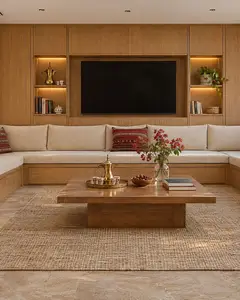
Keep the purpose and the form follows. A lattice screen between the front door and the living room gives you privacy without a solid wall, and the room still feels big. A lattice front on a cabinet hides the router, the receiver or an AC unit and still lets air reach it. Wardrobe doors with a lattice panel let a cupboard breathe, which your clothes will appreciate in a humid summer.
Light is the fun part. Put a warm LED strip behind a lattice panel and the pattern shows up at night as a soft shadow on the wall. A small panel above a door can borrow daylight from one room into a dark corridor. That is the mashrabiya's old trick, moved indoors.
A few practical points before you fall in love. The smaller the openings, the more privacy and the more dust, so put fine lattice where you want to hide something and open lattice where you want air. Lattice in a kitchen collects grease, so keep it away from the hob. And decide early which side faces the room, because a screen looks different from each side once the light is behind it.
Bring the idea home
If a lattice screen, door or cabinet front is on your mind, send us a photo of the spot and rough sizes through the furniture page, or start from our inspiration. We draw the lattice to your opening and make it to fit. The visit to measure is free, the price is fixed after we measure, and our workmanship carries 12 months of warranty from handover.
Quick questions
What is a mashrabiya?
A wooden lattice screen, traditionally made of small turned pieces, used on windows, balconies and between rooms. It filters sunlight, lets air through and keeps a home private. They were a familiar sight in old Cairo.
How are mashrabiya screens made?
Short pieces of wood are turned on a lathe, then fitted into polygonal joints to build up the lattice. The V&A describes the pieces of one Cairo screen as slotted together without nails.
Where can I see historic mashrabiya screens?
The Met in New York shows a screen with two gazelles in gallery 454, and the V&A in London holds turned screen fragments from Cairo.
Is a modern lattice panel the same as a mashrabiya?
Not quite. Most modern panels are flat boards with a pattern cut through them by machine. They give a similar light and look, and cost far less than true turned work.