What the Shakers knew about built in storage
The Shakers built cupboards and drawers into their walls and hung chairs on peg rails. Why that still works for a wardrobe or kitchen in the UAE.
By the Ajusteur team5 minute read
In this essay
Who were the Shakers?
The Shakers were a Protestant community who came to America from England in 1774, led by Ann Lee. At their height in the mid nineteenth century they had more than 6,000 members in eighteen communities, from Maine to Kentucky. The largest was New Lebanon, New York, founded in 1787 and active until 1947.
They grew their own food, raised their own buildings and made their own furniture. That last part is why furniture makers still talk about them, almost two centuries later.
Source: The Met: Shaker Furniture, Nicholas C. Vincent (2012)
Storage built into the room
The Met puts it neatly: to make the most of their space, the Shakers either built case furniture into the room itself or, if it stood free, designed it to fit a particular spot.
The National Park Service says built in cupboards and drawers were used extensively, and that a Shaker craftsman designed a piece knowing its exact purpose and where it would stand in the room. That is a fitted wardrobe brief, written in the 1800s.
Sources: The Met: Shaker Furniture, Nicholas C. Vincent (2012), National Park Service: Shaker style
A room you can still walk into
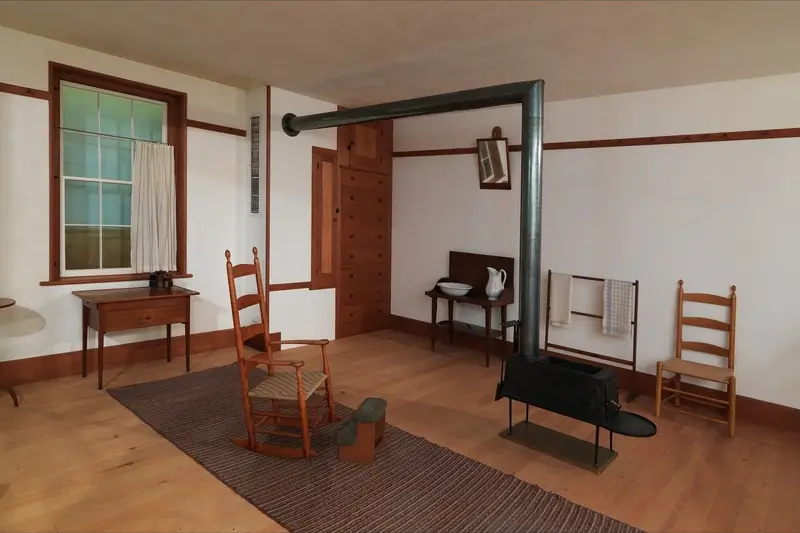
At The Met in New York you can stand in one. The Shaker Retiring Room in gallery 734 is installed with woodwork from the North Family Dwelling at Mount Lebanon, dated about 1830 to 1840. The dwelling was five storeys tall, and this room was a bedroom that several women shared.
A pegboard runs around the walls, and cupboards are built into them. The Met says the pegboard lifted things off the floor for easier storage and daily cleaning, and that the built in cupboards, pegboards, plain furniture and stained woodwork show three Shaker traits: utility, simplicity and beauty.
The peg rail, the cheapest storage in the house
A strip of wood with turned pegs, fixed along the wall. The National Park Service says Shaker peg rails often ran along all four walls, for garments, chairs, hats or baskets. The Met adds that some Shaker chairs had a low single slat back, so they could slide under a table or hang on the wall pegs when not in use.
Hang the chairs, sweep the floor, put them back. It sounds quaint until you try it in a small entrance hall with three children's school bags.
Sources: National Park Service: Shaker style, The Met: Shaker Furniture, Nicholas C. Vincent (2012)
Hancock's drawers, and a small mystery
At Hancock Shaker Village in Massachusetts, the museum describes built in units of cupboards and drawers as what best sums up Shaker buildings today. In Hancock's Brick Dwelling, those built ins share a joinery technique found only at Hancock, Tyringham and Enfield, Connecticut: dovetailed drawers whose sides taper.
Why they tapered them is unknown. Woodworkers have puzzled over it for decades. We like that. Even the plainest drawer can carry a maker's signature.
Source: Hancock Shaker Village: Made in Massachusetts, furniture from the Hancock Shaker Village collection
Plain on purpose
Canterbury, in New Hampshire, was founded in 1792 as the sixth Shaker community, and its Dwelling House went up in 1793. The Shaker leader Joseph Meacham asked that work be done faithfully and well, but plain and without superfluity.
The rules followed. The Millennial Laws of 1821 restricted decorative features. Shaker makers dropped veneer, inlay and carving, and used simple turned wooden knobs instead of imported brass pulls. We would not go quite that far: a veneered board is perfectly honest when the quote says what it is. The useful part is the habit of asking what each detail is for.
Sources: Harvard Magazine: Canterbury Shaker Village, in New Hampshire (2017), National Park Service: Shaker style, The Met: Shaker Furniture, Nicholas C. Vincent (2012)
Why a wall of storage still makes sense here
A wardrobe or cupboard built into a wall uses the whole wall. There is no gap behind it for dust, no ledge on top for forgotten suitcases, and no strip of wasted space at the ends. In UAE homes, where ceilings often run well above a standard wardrobe and walls are rarely perfectly square, that difference is easy to see.
It also stays put. Furniture that is part of the room does not wobble, does not need to be moved to clean behind, and keeps its doors lined up for years.
What to take for your wardrobe
Do what the Shaker maker did: start from what goes inside. Count your long hanging, short hanging, folded piles and shoes before you think about doors. Then size the bays around them. Our guide to wardrobe internals by width shows what fits in each bay.
Take the wardrobe to the ceiling, put the things you use twice a year at the top, and keep the fronts plain. Then add one peg rail by the bedroom door for tomorrow's clothes and the bag you always look for. When you are ready, plan your wardrobe.
And for your kitchen
The same idea works in a kitchen. A tall pantry with deep drawers holds more, and shows you more, than a cupboard full of shelves. Store each thing where you first use it, so the pans live by the hob and the cups by the kettle. Plain fronts, a simple handle or none, and a box built to fit the wall exactly.
Inside the cabinets, the dull grid of holes matters more than it looks. Here is what the 32 mm system means for your cabinets. Or sketch your kitchen and see an estimate. We come to measure for free, fix the price after we measure, and our workmanship carries 12 months of warranty from handover.
Quick questions
What is Shaker style storage?
Plain cupboards and drawers built into the wall or made for a particular spot, with peg rails for hanging things off the floor. The Shakers designed each piece knowing exactly what it would hold and where it would stand.
Where can I see a Shaker room?
The Met in New York shows a Shaker Retiring Room in gallery 734, with woodwork from the North Family Dwelling at Mount Lebanon, dated about 1830 to 1840. Hancock Shaker Village in Massachusetts and Canterbury Shaker Village in New Hampshire are museum villages.
Is a built in wardrobe better than a freestanding one?
In a room with high ceilings or walls that are not square, usually yes. It uses the full wall, leaves no gaps to collect dust and stays aligned. In a plain room with a free wall, a freestanding piece can cost less.
What is a peg rail for?
A wooden rail with pegs, fixed along the wall, for hanging coats, bags, hats or even chairs. The Shakers used them to keep floors clear and easy to clean.
Sources
- The Met: Shaker Furniture, Nicholas C. Vincent (2012)
- National Park Service: Shaker style
- The Met: Architectural elements from a Retiring Room in the North Family Dwelling, New Lebanon, New York
- Hancock Shaker Village: Made in Massachusetts, furniture from the Hancock Shaker Village collection
- Harvard Magazine: Canterbury Shaker Village, in New Hampshire (2017)